




Tastes of Greece: a guide to Greek foods and products
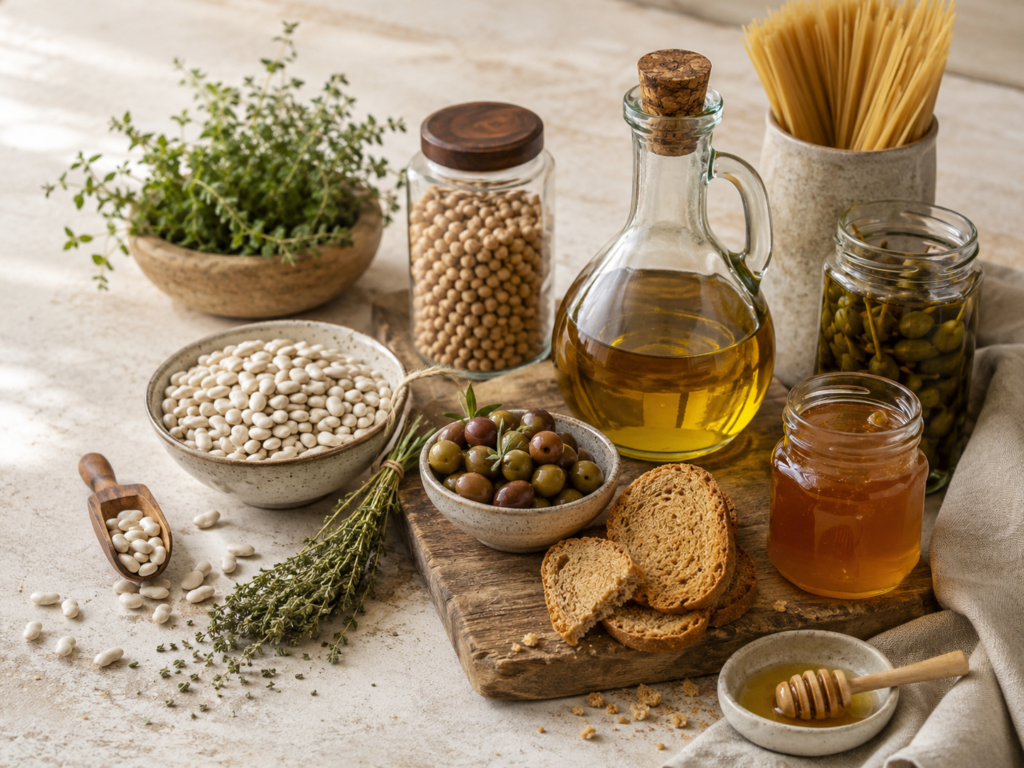
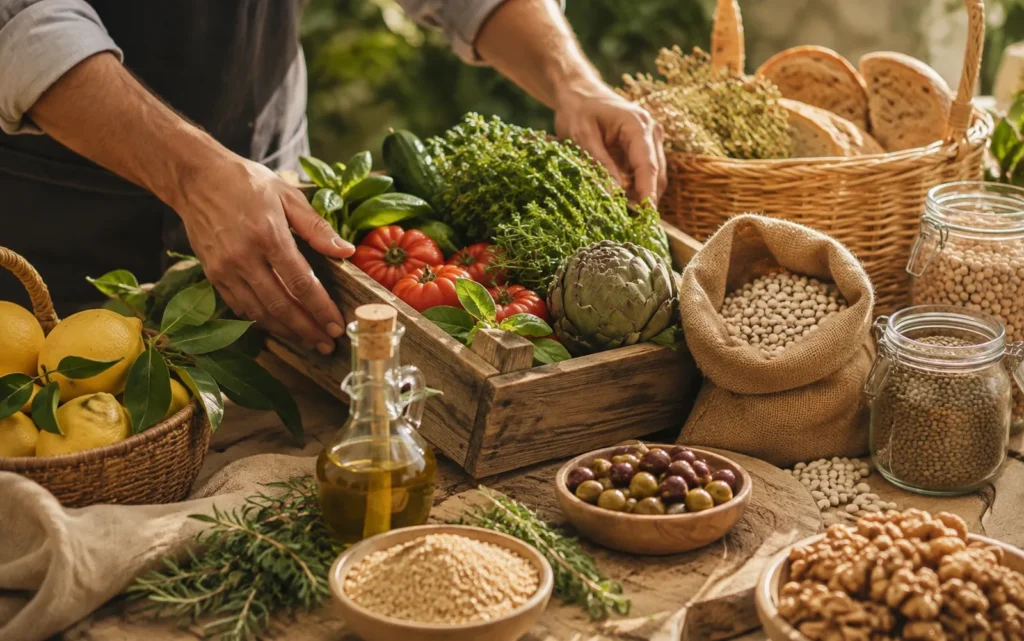
In Greece, food doesn't start with the recipe. It starts with what's on the shelf and what the season has brought.
This page is a guide to that shelf: what we keep in the Bakalokarpos, where it comes from and how it is used in the kitchen.
It is not a list of nutritional advice. It is a tour of flavors, ingredients and ways to use, with links to the categories where you will find the products.
What you will find on our shelves
- The Greek dietary tradition and indications of origin
- Oils, vinegars and salad dressings
- Herbs, spices and salt
- Legumes, pasta, rice and cereals
- Breakfast, sweet flavors and spreads
- Snacks, fruits and nuts
- Superfoods
- Drinks
- Sauces, vegetables and pickles
- The producers behind the shelves
- Where can you find us?
The Greek dietary tradition and indications of origin
The Mediterranean diet as a cultural tradition
The Mediterranean diet is not a diet plan. It is a way of eating, tied to agriculture, seasonality, and the common table.
UNESCO has inscribed it on the Representative List of the Intangible Cultural Heritage of Humanity, with Greece among the countries that share it.
What we keep from this tradition on the shelf is simple: few ingredients, good ingredients, and knowledge of what each one does.
What do PDO, PGI and EPD mean?
You will often see three acronyms in Greek food, and they don't mean the same thing.
PDO, Protected Designation of Origin, means that all stages of production take place in a specific area and that the product owes its characteristics to it.
PGI, Protected Geographical Indication, means that at least one stage is associated with the area.
EPIP, Traditional Speciality Product Guaranteed, does not refer to a place but to a traditional composition or preparation method.
These indications are registered in an official European register. Where a product of ours bears such an indication, it is mentioned on the product page and not generally here.
Oils, vinegars and salad dressings
Olive oil and oils
Olive oil is the ingredient that defines the flavor of a Greek dish more than any other.
It works in three different places: raw at the end, where it retains its aroma, in cooking as a base, and in baking where it binds the ingredients.
A fresh, bold oil isn't always the right choice for every use — in a stir-fry it might overwhelm vegetables, while in a simple salad it's exactly what you want.
Alongside olive oil, we also keep other vegetable oils for specific uses, from frying to baking.
For all options, see all oils and greases.
Vinegars: acidity that balances the flavor
Vinegar does to a dish what salt does, but on the other hand: it opens up the flavor instead of concentrating it.
A wine vinegar is sharp and goes well with legumes and fatty dishes that need a counterbalance.
Sweeter, aged vinegars work best on roasted vegetables and in salads with fruit or nuts.
For different flavors and uses, see all vinegars.
Salad dressings: ready-made combinations
A salad dressing is oil, acid, and something that holds them together.
Ready-made combinations help when you want a consistent result or when the salad is the main dish and not the side dish.
For ready-made salad combinations, see all salad dressings.
Herbs, spices and salt
Herbs and spices: where does the aroma come from?
Herbs and spices are the two largest categories on our list, and they are not used in the same way.
Dried herbs are at their best when they're added early and have time to soak in liquid — oregano in tomato sauce, bay leaf in legumes, thyme in roasts.
Ground spices are the opposite: they lose their aroma quickly in heat, so they are added slowly or in oil for a while so they open up without burning.
Whole spices last much longer than ground ones. If you rarely buy them, go for whole ones and grind them right away.
For all options, see all herbs.
For blends and individual spices, see all the spices.
For the most expensive spice on the shelf, see saffron.
Salt and flour: the two ingredients we don't pay attention to
Salt doesn't just add saltiness; it regulates how clearly we perceive all other flavors.
The grain matters: coarse salt works in water and in baked goods, fine salt in kneading and finishing a dish.
In flours, the difference is strength and grinding. A hard flour gives elastic dough for bread, a soft one gives a tender result in sweets.
Whole wheat flours and alternative flours also change the moisture content of the recipe, so they are rarely substituted one for one.
For available options, see all kinds of salt.
For bread, sweets and cooking, see all flours.
Legumes, pasta, rice and cereals
Legumes: the basis of Greek cuisine
Legumes are the dish that kept the Greek table going all winter, and they are still one of the easiest things to cook well.
The difference between a good and a mediocre legume dish is almost always time: soaking where needed, and boiling until the legume is tender to the core without falling apart.
Each type behaves differently. Lentils don't need soaking and are cooked quickly, broad beans require time and patience, black beans hold their shape and go well with rice and peppers.
For beans, lentils, chickpeas and the rest, see all legumes.
Pasta, rice and cereals
In pasta, shape is not decorative: it determines how much sauce each piece holds.
Small, thick shapes lift thick sauces, while thin ones go well with oil and simple ingredients.
In rice, the variety determines the result — one type of rice for pilaf that we want to remain grain-by-grain, another for creamy dishes and stuffed dishes.
Cereals and flakes cover breakfast and baked goods, from oats and bulgur to sesame and flaxseed.
For shapes and varieties, see all pasta.
For pilafs and stews, see all rice.
For flakes, groats and seeds, see all cereals.
Breakfast, sweet flavors and spreads
Honey and sweeteners
Greek honey completely changes character depending on where the bees foraged.
Thyme is intense and aromatic, flower honey is milder and lighter in color, forest honeys are darker and less sweet in taste.
In practice, this means that a strong honey is not always the right thing: in a yogurt you want it, in a drink it can cover everything.
Alongside honey, there are other sweeteners, with different intensity and different behavior in baking.
For bee varieties and products, see all honey and bee products.
For different uses in drinks and recipes, see all sweeteners.
Jams and spoon sweets
Jam and spoon sweets start from the same material and end up as two completely different things.
Jam is a spreadable dessert. The spoon dessert holds the fruit, whole or in pieces, in syrup, and is served in small quantities.
The second is one of the few things in Greek cuisine that is still served the same way for generations: a spoon on a saucer, with water next to it.
For seasonal fruits and traditional preparations, see all the jams and spoon sweets.
Nut butters and spreads
A good nut butter has one ingredient, or two if there is salt.
The texture changes depending on the grinding and whether the fruit has been roasted: raw gives a milder flavor, roasted gives a deeper flavor.
In the kitchen, they're not just for bread — they thicken sauces, go into doughs, and balance dishes with acidity.
For taste, texture and serving methods, see all nut butters and spreads.
Dairy products
The category is small and specific: options that work for breakfast and cooking.
For available options, see all dairy products.
Snacks, fruits and nuts
Nuts and fruits
Nuts are the easiest snack and cooking ingredient at the same time: walnuts, almonds, cashews, pine nuts, seeds.
The raw and roasted versions are not interchangeable — roasting changes the flavor and texture, and in a salad the difference is obvious.
Next to them, raisins and dehydrated fruits add sweetness without added sugar to the recipe, and are suitable for both desserts and rice or legume dishes.
For snacks and use in recipes, see all nuts.
For dehydrated options, see all fruits.
Nuts, pastries and bars
Rusk is bread that was made to last, and this also defines the way it is served.
It needs a little water or tomato to soften it, and then it's topped with oil, cheese, olives, or whatever's in season.
Pastels and bars are the portable version of the same thing: nuts and honey or syrup, in a form that fits in your bag.
For barley, wheat and other species, see all the nuts.
For snacks with nuts and honey, see all the pastels and bars.
Superfoods
The «superfoods» category in our list is not a snack. They are mainly powders, seeds, and concentrates that are put in small amounts inside something else.
Here you will find quinoa, chia seeds and flaxseed, powders such as matcha, moringa and turmeric, plant proteins, raw nuts and dried fruits.
The practical way to use them is simple: the seeds and flakes go into yogurt, salads and pastries, the powders into drinks and pasta, and quinoa is cooked like a cereal.
The powders have a strong flavor and are used in teaspoons, not tablespoons.
We make no health claims for any of these products. If you are looking for something for a specific health reason, please speak to a doctor or dietitian.
To see what the category includes, see all superfoods.
Drinks
Tea, coffee and beverages
Tea and herbal teas are among the categories where temperature and time matter more than quantity.
Herbal teas require boiling water and longer steeping times, while green teas become bitter if the water is too hot.
Coffee and other beverages cover daily use, hot or cold.
For varieties and blends, see all teas.
For the daily mug, see all the coffees.
For hot and cold options, see all drinks.
Juices and soft drinks
Juices and soft drinks complement the table and the recipe — several juices also work as ingredients, in marinades and desserts.
For available options, see all juices and soft drinks.
Sauces, vegetables and pickles
Sauces, mayonnaises and mustards
A sauce changes a dish faster than any other ingredient, which is why it's worth having two or three that you trust instead of ten that you don't use.
Mustards vary greatly in intensity, and the same amount of two different mustards gives a completely different result.
For options on different dishes, see all sauces, mayonnaises and mustards.
Standardized vegetables and pickles
Pickling is the oldest way to preserve produce, and at the same time an ingredient with its own place on the plate.
The acidity and crunchy texture act as a counterbalance to fat and heavy cooked dishes, which is why they traditionally accompany legumes and meat.
Standardized vegetables cover the practical side: ready-made ingredients for a sauce or an out-of-season salad.
For pickles and prepared vegetables, see all standard vegetables and pickles.
The producers behind the shelves
Who makes what we sell?
Behind the list are 45 producers and small businesses, and each product bears the name of its own.
Some of them with the most products on our shelves: Vlamis, Health Trade, Almopia, Agrozymi, Cretan Nectar, Lampropoulos and Petromylos.
If you want to support specific small producers, the most direct way is to see what each one makes and order directly from their page.
From which parts of Greece?
The origin is listed on each product, and you can also start from the place instead of the category.
For what is produced in Greece, see all Greek products.
For specific locations, see the products of Syros, Cretan products or the products of Chios.
Where can you find us?
The grocery store and the missions
Bakalokarpos is a grocery store in Athens, based in Kypseli, at 92 Kypselis Street.
Orders are placed from the online store and shipments cover the entire European Union, with a minimum order of 10 euros.
If you prefer to ask something before ordering, you can call 212 105 9849.
Sources and documentation
UNESCO data was used to refer to the Mediterranean diet as an element of intangible cultural heritage.
For the PDO, PGI and EPIP indications, official information from the Ministry of Rural Development and Food and the European Commission was used.
For the framework of permitted health claims on foods, Regulation (EU) 432/2012 is taken into account.
- UNESCOMediterranean diet — Representative List of the Intangible Cultural Heritage of Humanity
The registration of the Mediterranean diet in the intangible cultural heritage.
- Ministry of Rural Development and FoodPDO, PGI and EPI
The official framework and registry of Greek products with an indication of origin.
- European CommissionGeographical indications and quality schemes explained
What do European quality labels mean in practice?.
- EUR-LexRegulation (EU) 432/2012
The list of permitted health claims for foods in the EU.
Links lead to official third-party sources. Last checked: August 2026.